Eine deutsche Version dieses Beitrags findest du hier.
What is “hit quality”?
“Hit quality” refers to “how good” a hit is.
- In an earnest fight with sharp swords, hit quality is determined by the effect the strike has on the struck person and by the conventions of the fight
- In a sporting competition, hit quality is determined by the rules and a hit needs sufficient quality to be a valid scoring action
- In training or in friendly bouts, hit quality is determined by the participants
Why does hit quality matter?
There are two facts that stand in tension with each other:
- It is generally bad for your wellbeing to allow yourself to be struck by a sharp sword
- Not all strikes with a sharp sword will wound (and not all wounds are fight-ending)
Fencing training that wants to appeal to a historical context involving earnest fights with sharp swords needs to contend with both of these facts.
- Training that focuses too much on fact (1) runs the risk of treating swords like death wands and devolving into “sword tag”
- Training that focuses too much on fact (2) runs the risk of treating swords like blunt bludgeons and devolving into “boxing with sword-shaped sticks”
Any standard for hit quality is an attempt to establish a compromise between these two facts for the purpose of training fencing.
My Personal Preferred Standard™
Any standard will be a little bit arbitrary and will be influenced by our beliefs about what is important in fencing and how we believe a fight “ought” to go. I haven’t done a comprehensive survey of all available data about how humans react to sword strikes and I have zero first-hand experience with real sword fights. This is just my opinion, albeit one informed by a deep familiarity with a wide variety of historical fencing literature.
The questions guiding my personal preferred standard for hit quality are the following:
- Are there any strikes that we want to exclude for sake of safety?
- Would the strike probably have done meaningful damage had the sword been sharp?
- Was the strike intentional or incidental?
From these priorities, we can make a flowchart showing how to adjudicate a touch:
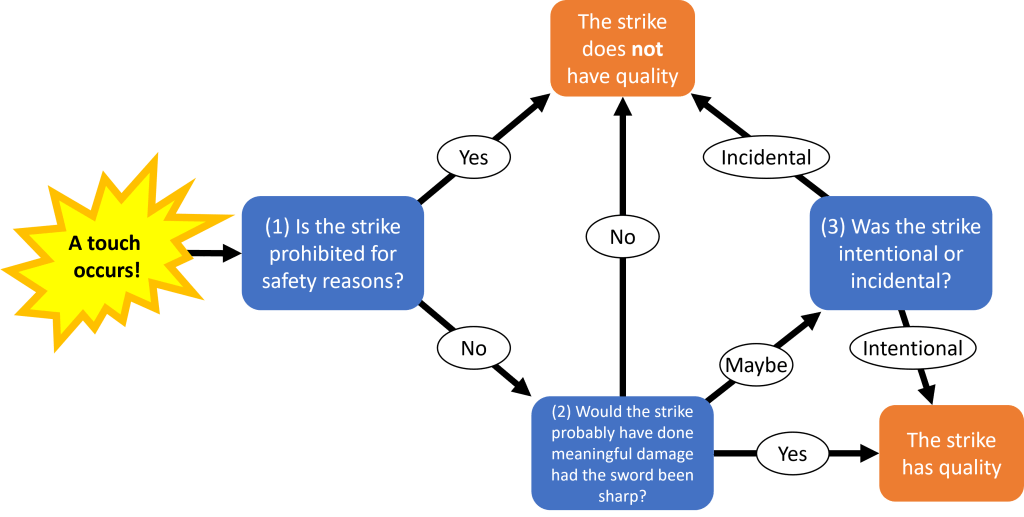
Judgement is required for all three of the questions. Rather than attempting to replace judgement with a list of rules, the quality standards I outline in this post will offer a list of considerations that I believe should influence your judgement. Think of these considerations as “symptoms” of a good hit: the presence of a single “symptom” does not necessarily indicate a good hit, but the more “symptoms” apply, the more likely it is that the hit had good quality.
Because different strikes wound in different ways, I like to apply a different standard for different kinds of strikes.
Standard for Cuts
A cut is when the edge of the sword is swung at the target with a hewing or chopping motion. It is different from a slice in that it has momentum behind it.
- do not judge the quality of cuts merely based on the momentum of the sword
- While swinging harder is an effective way of making a cut more dangerous, swinging harder also endangers our training partners and we do not want to encourage dangerous fencing (see priority 1)
- do judge them based on:
- Edge alignment
- Did the edge actually make contact with my opponent?
- Is the edge directed at the target throughout the strike or does the blade make a “scooping” motion, compromising the cutting potential of the strike?
- Point of contact with the blade
- Was the cut made with a part of the blade that can cut (well)?
- A typical longsword cuts best near its center of percussion (about 70% of the way up of the total length from the pommel) and cuts poorly with the portion of the blade near the very tip or near the hilt
- Was the cut made with a part of the blade that can cut (well)?
- Distance traveled
- Did the sword move through a wide arc, or only a short distance?
- Opposition
- Was the cut parried before it hit a valid target, partially arresting the cut’s momentum?
- Was the cut partially obstructed by a parry, or was the path of the cut totally open?
- Posture
- Is my body oriented in a way that can easily exert force into the target, or do I need to contort my body to bring the edge into contact with my opponent?
- Is it clear that I am in a good position to deliver a cut with quality, but I’m abstaining merely for the comfort or safety of my training partner?
- Intentionality
- Was the cut done on purpose or was it incidental?
- Edge alignment
Standard for Thrusts
A thrust is when the point of the sword is pressed into the target.
- do not judge the quality of a thrust merely based on whether the blade bends
- an unarmoured target can be pierced by a sharp point with a weight-equivalent force of roughly 1-2 kilograms, sometimes even less, but many training swords only flex at much greater levels of force
- Protective gear (such as a fencing mask) is often designed to deflect strikes for safety purposes that would otherwise have struck true
- do judge them based on:
- Point of contact with the blade
- Did the point actually make contact with my opponent?
- Posture
- Is my body oriented to apply pressure through the point or do I need to contort my body to bring the point into contact with my opponent?
- Is it clear that I could deliver a thrust with 1-2 kilos weight-equivalent force, but I’m abstaining merely for sake of the comfort of my training partner?
- Intentionality
- Was the thrust done on purpose or was it incidental?
- Point of contact with the blade
Standard for Slices
A slice is when the edge of the sword is dragged across the target. In contrast to a cut, a slice does not require momentum. A cut that is robbed of its momentum can easily become a slice.
- do not judge the quality of a slice merely based on whether the edge of the blade makes contact with the opponent’s body
- A slice requires pressure into the target and dragging the edge across the target – simply laying the edge on the opponent is not sufficient
- do judge them based on:
- Pressure + Push or Pull
- Are both requisites for a slice fulfilled? Both pressure into the target and pushing or pulling the edge across the target?
- Body structure
- Am I pressing my blade into my opponent and disrupting their structure, or do I need to disrupt my own structure in order to make contact between the edge of my sword and my opponent’s body?
- Opposition
- Am I trying to press my sword through or around my opponent’s sword while they are actively defending? If so, I’m probably going to have a harder time making an effective slice.
- The location of the slice
- A shallow cut across the crown of the head or the ribs is probably just a flesh wound, but a shallow slice across the neck or throat can be deadly
- Intentionality
- Was the slice done on purpose or was it incidental?
- Did I try to make a cut or thrust, but the cut was partially obstructed by a parry and my edge made incidental contact with my opponent? That is unlikely to be a good slice without further action on my part.
- Pressure + Push or Pull
Standard for blunt force blows
- Pommel strikes only have quality if they can be simulated while ensuring the safety of your opponent (usually while in a dominant position in a grapple)
- No other blunt force blows have quality
- Strikes with the crossguard of the sword would also be effective, but are excluded for safety
- Other kinds of blunt force attacks are certainly possible, but it is difficult to know how effective they would be without actually hurting your training partner
- While unarmed strikes such as punches certainly can distract or even knock out an opponent, a single punch is far less likely to end the fight than a single sword strike, so it makes sense to discourage punches unless you have a position of dominance (see “wrestling/throws” below)
- Whether kicks are permitted is something the fencers should discuss in advance, but – if permitted – kicks should not be scoring actions but a means by which to achieve a hit with quality with the weapon
- A powerful kick can certainly break bones or cause pain, but that is not appropriate for sparring
Standard for wrestling/throws
- Whether wrestling, throws, and joint locks are permitted is something the fencers should discuss in advance
- If permitted, wrestling is a means by which to achieve a hit with quality with the weapon, so throwing your opponent is not (necessarily) sufficient to end the exchange, although you may want to end the exchange after a throw anyway
- That said, if you can establish a clear position of dominance in a grapple, you don’t need to actually hit your opponent with a weapon strike to end the exchange; how far you want to go is also something you should discuss with your partner ahead of time
Some additional tips
- If a fencer struck themselves with the same blow, would you count it as a “self-wound”? If not, then such a strike probably shouldn’t count when it hits the opponent.
- For example, a lot of fencers rest the blade of their own weapon on their shoulder, but we don’t consider that sort of contact a “self-wound”. It follows, then, that if they place their blade on the opponent’s shoulder in a similar manner, we probably shouldn’t count that as a hit with quality either.
- A cut that is robbed of its momentum through a parry and then makes contact with the opponent should be treated like a slice, not a cut
- If a person is attempting to make a strike while their weapon arm is being controlled by the opponent, the quality of their strike should be scrutinized more closely
- Strikes made while the weapon arm is controlled are generally not well-formed
- If a person is attempting to make a strike while being thrown, the quality of their strike should be scrutinized more closely
- Strikes made while being thrown are generally not well-formed
- As a rule of thumb, I would say thrusts > cuts > slices
- Why? Because thrusts are easy to do effectively and are very dangerous and cuts are generally more dangerous than slices because of the momentum behind the edge.
- So, as an example, if you stab your opponent in the face and they cut you in the head, the stab to the face is probably going to be more effective than the cut (although neither fencer in this example should be particularly proud of their result)
- Here’s a cool video analysis of some concrete examples
Aspirational Fencing
Hit quality standards should be a training tool, not an excuse.
A classic example calling for nuanced judgement: If a cut is partially parried and lands as a slice with questionable quality, the struck fencer might not have been seriously wounded, but still failed to parry completely successfully. At the same time, the fencer who struck should recognize that their attack was partially blocked and might not have been very effective, so halting the action after the questionable slice might be inappropriate. However, if the attacker delivered that questionable slice while maintaining control and exiting the situation safely, that is still aspirational fencing!
Instead of asking “Is it possible that what I did could have worked?” measure your fencing by asking yourself honestly “Was what I did aspirational?”
- Be polite, attentive, and considerate towards your training partners
- Fence with intentionality; getting lucky is great, but not a good strategy
- Try to hit with good quality
- Do not assume that your hits will be immediately acknowledged by your opponent, instead assume by default that your hit did not have sufficient quality and remain prepared to defend yourself
- Rely on the good quality of your own defence instead of hoping your opponent hits with poor quality
- Accept ambiguous exchanges as suboptimal and move on rather than debating who is “more dead”
 Blume des Kampfes
Leave a comment