Eine deutsche Version dieses Beitrags findest du hier.
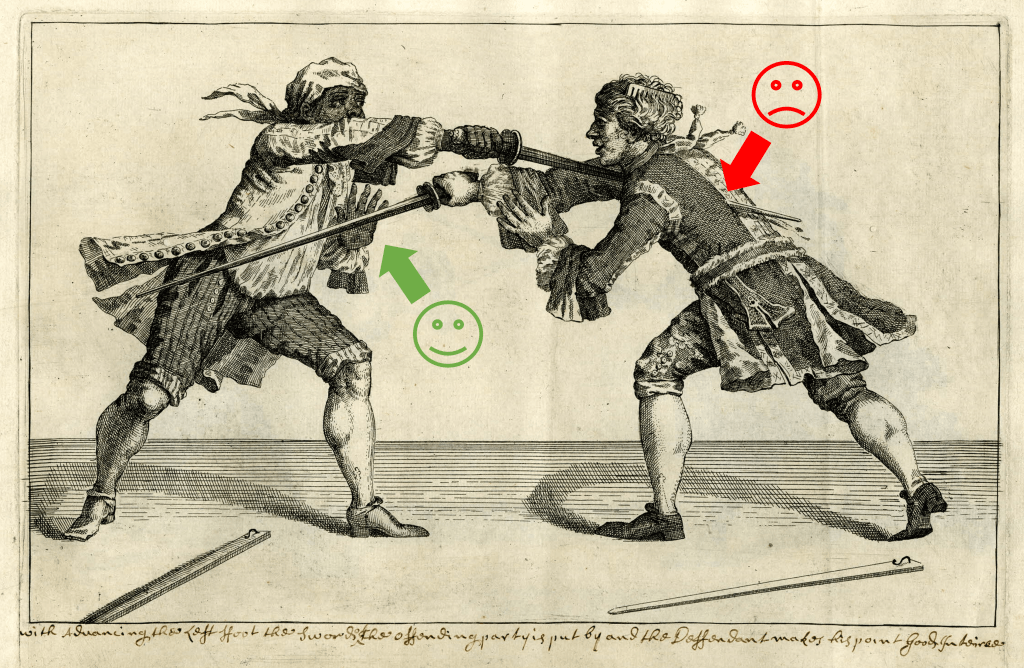
The goal in fencing is to hit the opponent without being hit in return. More specifically, we want to hit effectively without being hit effectively in return. What “effectively” means is context dependent and sometimes ambiguous.
In modern Olympic sport fencing, for example, touches are detected by an electronic scoring machine and not every touch with the weapon is valid:
- A thrust with a foil requires at least 500g to depress the tip and must lie within the target area to be valid
- A thrust with an épée requires at least 750g to depress the tip and the full body is valid target
- A cut or thrust with a sabre is valid as long as the blade touches the valid target area
As such, a fencer needs to be prepared for the possibility that the weapon only grazes the target or that the opponent manages to dodge just enough. Right of way notwithstanding, it’s pretty clear whether a touch is valid or not.
Many historical fencing sources, by contrast, discuss fighting in earnest with sharp swords. What “fighting in earnest” means is very context dependent; it does not necessarily mean “fighting with intent to kill”. However, generally we can say that earnest fencing differs from sport fencing in that the validity of a hit is not only determined by rules, but also by the effect the hit has on the opponent. Many historical fencers attempt to apply this mindset in their own fencing. If you want to do that, you need to understand the concept of “hit quality”.
Hit Quality
In this context, when we talk about the “quality” of a hit, we’re talking about the effect the hit would have if the training weapon were a sharp sword. There are two aspects to “quality”:
- The wounding potential of the strike
- A strike with the flat of the blade might hurt, but it might not have any other effect on the struck person
- A cut with the edge of the blade, but with poor edge alignment, might only cut through the struck person’s clothing without wounding
- The effect the strike would have on the ability of the struck person to continue fighting
- A strike with the flat of the blade might not inflict any meaningful physical damage, but it may unsettle or distract the struck person
- A cut with poor edge alignment might have less wounding potential than a well-formed strike, but a poorly executed strike against a fragile body part could still render the opponent unable to continue fighting
As you can imagine, both aspects of hit quality can be difficult to judge. This fact has resulted in a lot of debates among modern martial artists and fencers as well as historical fencing masters.
I certainly won’t be able to resolve these debates, but I can outline the thoughts behind them.
For concrete suggestions for hit quality standards for free fencing, see this post here.
If you’re uncomfortable reading descriptions of bodily injuries, I recommend you skip ahead to the section “Aspirational Fencing” below.
Wounding Potential of Strikes
Thrusts against an unarmored target have a very high wounding potential.
- Even a pocket knife can stab through ribs with relatively little force
- Since little skill is required to effectively stab, we can safely assume than any simulated thrust with moderate force would cause a wound
- Since thrusts don’t need much force to be effective, it is not necessary for a stab to have much momentum to be effective
The wounding potential of a simulated cut is very difficult to judge, because a diverse range of variables affect cutting performance. It takes a non-trivial amount of technique to cut well with a sword – that’s why test cutting and cutting tournaments exist. If a cut is particularly poorly executed, the sword acts as a mere bludgeoning weapon – a role for which it is typically poorly suited. In general, the following factors are relevant for the quality of a cut:
- Does the sword even have a cutting edge? Some swords are purely thrusting weapons, others may have an edge, but remain more thrust-oriented and are worse at cutting.
- How much momentum does the cut have? All other things being equal, a cut with more momentum will cut better.
- How stable is your structure? A posture that more efficiently transfers force from your muscles into the sword and then into the target will result in a better cut.
- How is the edge moving relative to the target?
- Is the edge even directed at the target?
- Changing the orientation of the blade during the cut can lead to a less effective cut
- Simply pushing or pulling the edge across a soft target can slice without the need for much momentum
- An edge that is not moving relative to the target cannot cut
Blunt force trauma is pretty intuitive and dangerous to the extent that it breaks bones, concusses brains, and causes internal bleeding. Since a blunt sword with realistic proportions, mass, and balance is just as effective at bludgeoning as the real thing, it’s hard to know how effective a blunt force strike would be without actually injuring your training partner. This is why you don’t see fencing with realistically weighted maces or clubs – a realistic simulator of a mace is hardly distinguishable from the real thing! Thankfully, swords generally aren’t the best bludgeons, so with adequate protective gear we can hit our opponent with realistic force for an effective cut without breaking ribs or fingers.
The Effect of Wounding
The effect of a wound on a person’s ability to continue to fight can be difficult to judge because humans are simultaneously incredibly resilient and incredibly fragile.
- Stabbing wounds to the torso are very deadly, but death is rarely instant and stabbing victims often do not notice that they have been stabbed until minutes later.
- Blunt force blows to the head can knock a person out even through armour, rendering the struck person unable to fight even if they ultimately survive.
- While blows to the head are never good, the skull protects the important organs well from cuts and thrusts, but less well from blunt force, which can lead to counterintuitive outcomes.
Cuts that hit the skull with force and violence are very severe, even if the wound to the skin is light. Those that form great wounds and which hew through the skull are infinitely less. The reasons for this difference are that in the first case the skull might have been shaken and that there might be an effusion of blood on the brain which is often ignored for quite some time. While in the second case the shock on the brain is less to fear and that you quickly see what you need to do. This is why penetrating wounds to the skull are less severe than those that deeply affect the bones.
Cutting wounds to the face are often less severe than those of the skull. They can be limited to the flesh, affect the bones and separate entirely one from the other.
Those of the collar are more or less severe depending on the parts that are affected. The section of the carotids is fatal, that of the trachea, the oesophagus and the flexor muscles of the head are very severe.
– from surgeon Hugues Ravaton’s 1768 Chirurgie d’armée; English translation by Maxime Chouinard here: “Very Perilous: A sword wounds compendium by the surgeon Ravaton”
- A light cut to the weapon arm can be harmless, but with a bit of (bad) luck, it can render the weapon hand useless. That may not be fatal, but immediately compromises the wounded person’s ability to fight.
- The role of emotions shouldn’t be underestimated; even in sport fencing with protective gear, a hard hit or a stab in the face can be disconcerting and distracting.
Those not bothered by descriptions of bodily harm might find this anecdote from an 18th century French surgeon interesting:
One interesting case is that of two Grenadiers of the Saint Germain Regiment who hacked each other. The first had received a sabre cut along the sagittal suture which did not reach the brain, two cuts on the right side of the coronal which caused splinters, the right ear was gone, the nose was half cut, two cuts on his right hand with lesions to the tendons and three on the elbow along with two fingers of the left hand cut off. After treatments he left the hospital after sixty-five days.
The other grenadier also had a cut on his right parietal which had shattered a small part of the bone, two light cuts on the chin, a light one on the left wrist and another that cut through several tendons of the right hand. The wounds of the hands healed quickly, but after a few days he suffered from numbness in his left arm, cold sweat and pressure in his head and soon the limbs of the left side were paralyzed, the jaw and the tongue also became numb. The patient fell unconscious and died in convulsions. Ravaton noticed that blood had accumulated on the brain. These symptoms might sound like an intracerebral stroke. Ravaton was surprised by the result since he thought the first in more immediate danger than the second. His hypotheses were that either the first patient had a thicker skull, or that the sabre was sharper and had penetrated the skull more than it shook the brain, causing, ironically, less damage.
– “Very Perilous: A sword wounds compendium by the surgeon Ravaton”
This is one of many historical examples of human toughness. The surviving fighter took at least 11 hits and the deceased only 5; had this happened in a training environment, we probably would have assumed that the deceased fighter “won”.
Aspirational Fencing
Both of the above aspects of “quality” are relevant for the interpretation of historical sources concerning fencing in earnest. However, debates about hit quality are sometimes used during fencing training as an excuse for why a hit taken shouldn’t count. Keep in mind:
Sparring isn’t a fight to the death!
Even if you wanted to prepare for a duel to the death, it would be better to practice steering the fight towards an unambiguous victory than to console yourself with the fact that your opponent suffered five life-threatening wounds and you only three during a chaotic fencing exchange.
At the same time, we shouldn’t completely ignore hit quality and consider any contact between the sword and body to be a valid hit. Fencing instructor Keith Farrell wrote a good article here taking a closer look at whether or not the historical sources we study are “a killing art“.
For concrete suggestions for hit quality standards for free fencing, see this post here.
“Therefore, when I teach my students, I don’t teach that swords are lightsabres, or that one hit = a kill. I teach that a well-formed strike will have the highest chance of doing damage, whereas a badly-formed strike will have very little chance of doing what you want it to do.”
– Keith Farrell, Is your art really “a killing art”?
We need to balance these considerations.
My recommendation: Measure your fencing by asking yourself honestly “Was what I did aspirational?”
- Be polite, attentive, and considerate towards your training partners
- Fence with intentionality; getting lucky is great, but not a valid strategy
- Try to hit with good quality
- Do not assume that your hits will be immediately acknowledged by your opponent, instead assume by default that your hit did not have sufficient quality and remain prepared to defend yourself
- Rely on the good quality of your own defence instead of hoping your opponent hits with poor quality
- Accept ambiguous exchanges as suboptimal and move on rather than debating who is “more dead”
 Blume des Kampfes
Leave a reply to Hit Quality: My Suggestions – Blume des Kampfes Cancel reply