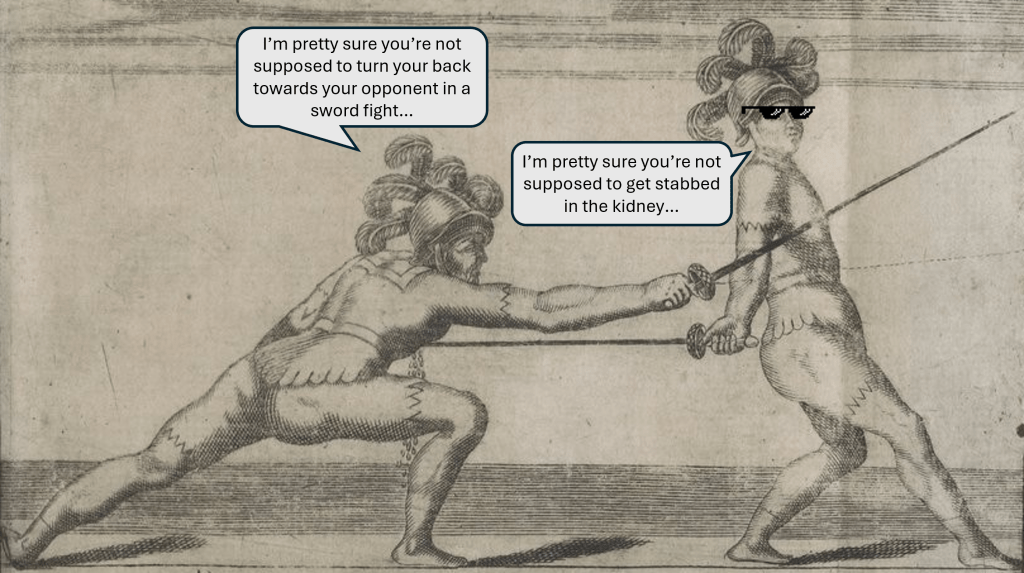
This is intended to be a “too long; didn’t read” summary of Charles Besnard’s 1653 fencing treatise Le maistre d’arme liberal based on my reading of the English translation by Anne Chauvat and Rob Runacres available here. This summary necessarily involves interpretation on my part, but I’ve tried to strike a good balance between brevity and accuracy.
Can you give me a “TL;DR” for your “TL;DR”?
How to fence (according to Charles Besnard):
- Your opponent has four ways of attacking you:
- Your inside, above your sword
- Your inside, below your sword
- Your outside, above your sword
- Your outside, below your sword
- Always close three of the four avenues of attack to limit the viable actions your opponent can make
- When engaging your opponent, close the direct line so that any attack your opponent makes must take a longer path to reach you
- When being engaged by your opponent, use your knowledge of which avenue is open to anticipate what your opponent can do
- Once so engaged, whether attacking or defending, be able to counter every possible action and reaction your opponent can make
- Simplify the infinite possibilities into a finite set of categories and have one or more practiced counters for each category
Obviously, that is all easier said than done. But that’s why there’s a whole treatise.
Sections of this Post
- The Source
- Who is Charles Besnard?
- What kind of sword?
- Outline of the Treatise
- Images
- A concise interpretation of the techniques
The Source
This entire blog post is based off of my reading of “The Free Master of Arms: A transcription and translation of Charles Besnard’s Le maistre d’arme liberal” by Anne Chauvat and Rob Runacres published in 2022 and sold through Fallen Rook Publishing here.
The book has four main sections:
- An introduction by the authors Anne Chauvat and Rob Runacres including biographical information about Charles Besnard, an overview of the historical context of his time, and an analysis of the treatise’s legacy
- A full transcription of Besnard’s treatise in the original French
- Copies of the original image plates
- An English translation of Besnard’s treatise
I greatly enjoyed the historical background information in the introduction and would recommend the book to someone interested in the subject based on that alone. This information set the stage for the treatise well and made Besnard’s last two chapters regarding pistol dueling seem less random than they might have otherwise. The fencing treatise, itself, is fairly concise with the English translation coming in at less than 100 pages in a reasonable font size. Besnard faces the same problem that everyone describing fencing in text does: it often takes a lot of words to describe an action that would be easy to demonstrate in person. Despite this, the treatise is clear, logically organized, and the descriptions of techniques are easy enough to imagine for a reader already familiar with fencing. I wish there were more pictures, but the three original image plates that depict fencing techniques are surprisingly sufficient to visualize the system. Aside from the quality of the fencing content, I also enjoyed what I felt was a sense of the historical author’s personality from the translation. Besnard regularly uses dramatic metaphors and colloquialisms and there are more than a couple of places where I got some “old man yells at cloud” vibes, which I chose to interpret as quaint!
Who is Charles Besnard?
Charles Besnard wrote a treatise on fencing called Le maistre d’arme liberal (“The Free Master of Arms”) published in 1653. Based on the biographical information in the transcription and translation by Anne Chauvat and Rob Runacres, he was probably born around 1615, died in 1675, and appears to have spent his life in or around the Breton city of Rennes.1 It is not clear how influential Besnard was in his own time. His treatise was reprinted in 1661 and his work was mentioned by another 17th century French fencing master, Philibert de la Touche, so he seems to have attracted at least some contemporary attention.2 However, the authors Chauvat and Runacres argue that late 19th century French nationalism gave Besnard his most lasting legacy where his work was held up as historical evidence of French innovation in swordsmanship.3
What kind of sword?
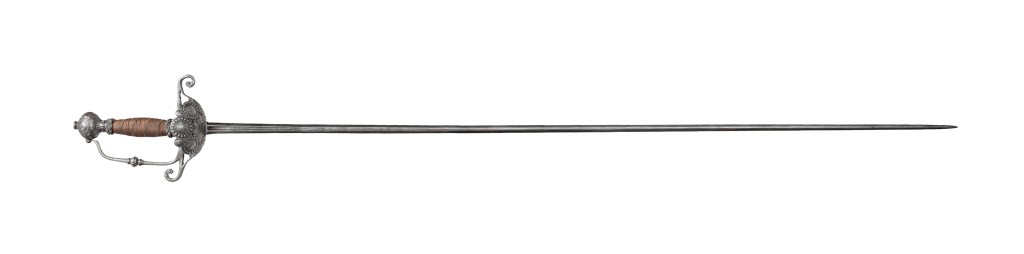
Besnard’s treatise covers “the theory, art, and exercise of the single sword or foil”.4 He distinguishes between the use of the sharp sword in earnest and the use of the foil in the fencing hall,5 but he does not describe the exact kind of sharp sword he has in mind.
The image plates depict a sword with a fairly long, slender blade and a shallow cup or dish guard with or without a crossbar. In the text, Besnard refers to the true and false edges of the sword6, and he does describe attacks with cuts in some techniques,7 but he seems to assume that both fencers are attacking and riposting almost exclusively with thrusts.
Based off of the images and text, I would therefore conclude that the sharp sword he has in mind is probably a sword with a long, thrust-centric blade with some limited cutting capacity.
Outline of the Treatise
Here is an overview of the topics discussed in the treatise presented in the order they appear in the original text.
- Dedication to the lords of the province of Bretagne
- Introduction
- Chapter 1: Fundamental concepts
- How to hold the sword
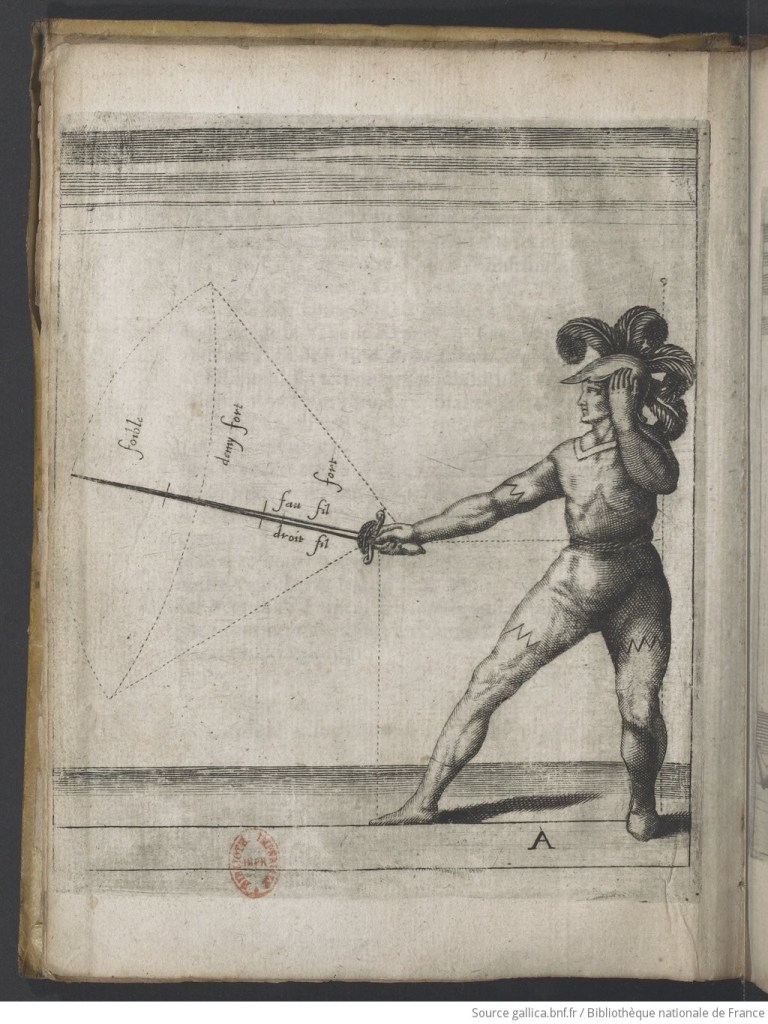
- How to stand in guard (see Plate A below)
- The parts of the sword
- The two edges of the blade
- the true edge
- the false edge
- The three thirds of the blade’s length
- the weak
- the half-strong
- the strong
- The two edges of the blade
- The four movements of the body
- Advance (stepping forward)
- Retreat (stepping backward)
- Bend very low to the inside
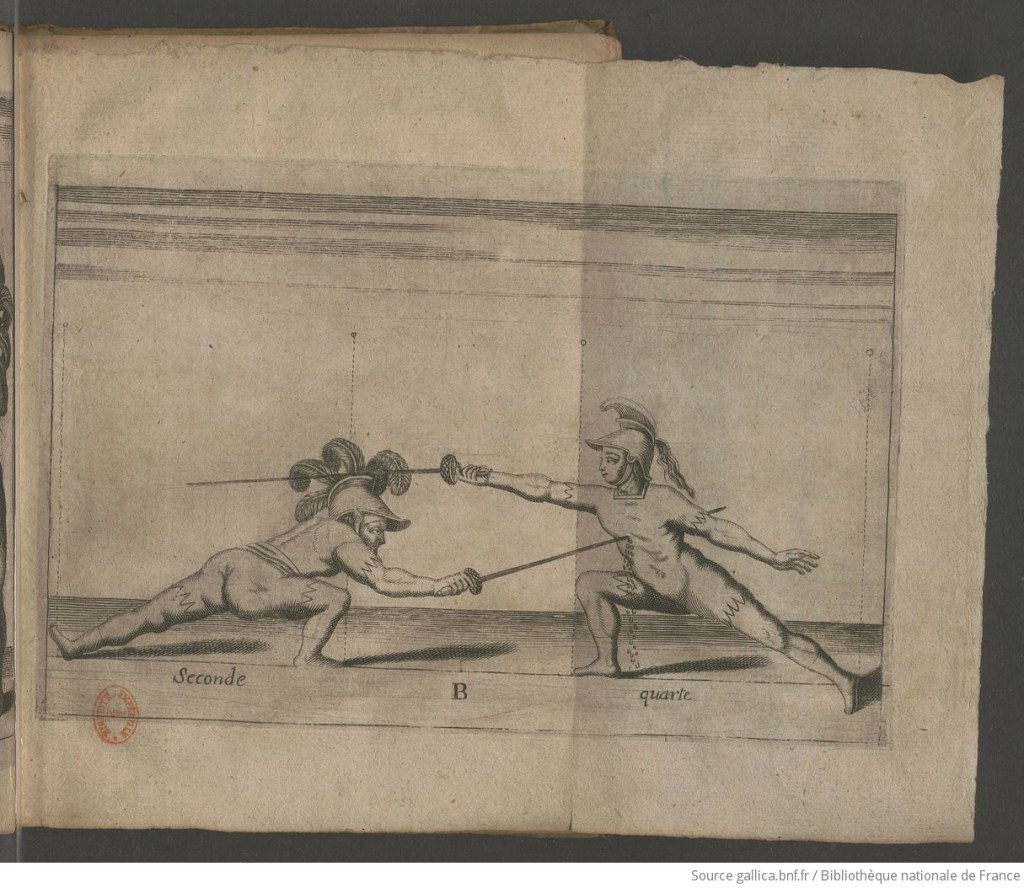
- See figure on the left in Plate B below
- Volte (a turn to the outside)
- See figure on the right in Plate C below
- The methods of advancing or retreating
- “Movement in walking”
- Moving one foot in front of or behind the other while keeping the lead shoulder forward
- “Closing the measure with the foot”
- Moving one foot at a time without changing which foot is the front one
- “Movement in walking”
- Concepts related to “tempo”
- Tempo: any fencing action, no matter how quick, is a tempo
- Same Tempo: when both fencers attack simultaneously (and hit each other simultaneously)
- Counter-Tempo: “The antidote of tempo”; an action made during an opponent’s tempo intended to counter it
- Count to the counter: a counter to a counter-tempo action
- Besnard claims that for every action there is a counter
- The four guards
- Although Besnard calls them “guards”, he uses these names to distinguish different attacks rather than stances
- The guards
- The four “Bottes” (attacks, blows)
- By my reading, “botte” is synonymous with “thrust”
- The Bottes
- the Botte of Première
- A thrust from high to low
- Not used or recommended by Besnard
- the Botte of Seconde
- From tierce to seconde
- From quarte to seconde
- See figure on the left in Plate B
- the Botte of Tierce
- See figure on the left in Plate C
- the Botte of Quarte
- See figure on the right in Plate B
- the Botte of Première
- Later in the techniques, Besnard refers to other kinds of attacks:
- Estramasson: Presumably a descending wrist cut from the fencer’s dominant side
- Revers: Presumably a descending wrist cut from the fencer’s non-dominant side
- “Cut into second”: Presumably a cut-like motion that ends in a botte of seconde
- Later in the techniques, Besnard describes two methods of attacking:
- On the firm foot: in the manner of a lunge
- Passing: passing the back foot forwards
- Knowing the principles is not enough
- Everything discussed so far are only principles and foundations
- Practice is necessary to actually be able to apply these principles and foundations
- Experts use the same postures and techniques as novices, but don’t be fooled into thinking that your mere knowledge of these fundamentals is sufficient to make you an expert too
- Heart without skill
- Besnard responds to people who say that there’s a big difference between fencing with blunt foils and fighting with sharp swords and that only courage is necessary in a real fight
- Courage is necessary but not always sufficient to prevail in a fight with sharp swords
- Good judgement and skill also help and practicing helps foster both
- Besnard responds to people who say that there’s a big difference between fencing with blunt foils and fighting with sharp swords and that only courage is necessary in a real fight
- Anger and overconfidence
- Besnard responds to people who say that experts often lose to novices
- He agues that, although this does sometimes happen, that doesn’t mean skill is useless, but rather that there were other factors involved that led to the loss of the more expert fighter such as:
- Fear
- Anger
- Overconfidence
- Poor judgement
- He argues that even very experienced people need to practice regularly to stay sharp and that being out of practice can lead to a loss against someone less experienced
- He agues that, although this does sometimes happen, that doesn’t mean skill is useless, but rather that there were other factors involved that led to the loss of the more expert fighter such as:
- Besnard responds to people who say that experts often lose to novices
- General advice for fencers
- Learn the basics diligently and accustom your body to the movements needed to fence well
- Practice and fence regularly
- Be neither too fearful nor too bold and instead exercise good judgement
- Chapter 2: How to apply the fundamentals
- Introduction
- It is important to be able to read your opponent’s intentions
- Learn to recognize your opponent’s…
- …movements
- …tempi
- …measures (distance, reach)
- …plans
- …intentions
- Learn to recognize your opponent’s…
- Of the infinite situations that can emerge in fencing, all be classified according to the following three binary characteristics:
- Are you initiating or is your opponent initiating?
- Are you engaging your opponent’s sword, or is your sword being engaged?
- Are you attacking, or is your opponent attacking?
- It is important to be able to read your opponent’s intentions
- The metaphor of the four doors
- Besnard introduces a metaphor that he refers to again and again in the techniques to come
- Suppose you are in a room with four doors and a person is trying to get inside and kill you – how would you defend yourself and kill him instead?
- You could lock all four doors so that the assailant cannot enter, but then you would be a prisoner: safe, but captive
- Instead, you should lock three of the four doors so that you know by which door the assailant will enter and be prepared to face him there
- Suppose you are in a room with four doors and a person is trying to get inside and kill you – how would you defend yourself and kill him instead?
- In fencing, your opponent has four ways of attacking you:
- Your inside, above your sword
- Your inside, below your sword
- Your outside, above your sword
- Your outside, below your sword
- In fencing, you should always endeavor to shut three of the four doors so that your opponent’s only viable avenue of attack is known to you
- Besnard introduces a metaphor that he refers to again and again in the techniques to come
- The salute
- Besnard describes a sequence of motions for saluting your opponent at the start of a bout
- Techniques Part 1: What to do when you are the one engaging
- Engaging an opponent who has closed their outside line
- How to engage in quarte
- Once engaged, how to deal with the four possible reactions:
- Your opponent disengages to attack you on the other side
- Your opponent disengages without attacking (either to feint or just change sides)
- Your opponent tries to take over the advantageous position in the engagement
- Your opponent does nothing and remains engaged
- Engaging an opponent who has closed their inside line
- How to engage in tierce
- Once engaged, how to deal with the four possible reactions:
- Your opponent disengages to attack you on the other side
- Your opponent disengages without attacking (either to feint or just change sides)
- Your opponent tries to take over the advantageous position in the engagement
- Your opponent does nothing and remains engaged
- Engaging an opponent who has their sword held high with the point upwards or otherwise out of reach
- How to engage the high guard
- Once engaged, how to deal with the four possible reactions:
- Your opponent disengages to attack you below
- Your opponent disengages without attacking (either to feint or just change sides)
- Your opponent tries to take over the advantageous position in the engagement
- Your opponent does nothing and remains engaged
- Engaging an opponent who has their sword held low with the point towards the ground
- How to engage the low guard
- Once engaged, how to deal with the four possible reactions:
- Your opponent disengages to attack you above
- Your opponent disengages without attacking (either to feint or just change sides)
- Your opponent tries to take over the advantageous position in the engagement
- Your opponent does nothing and remains engaged
- Miscellaneous topics
- Why parrying with the offhand is dangerous
- What if my opponent is so good that they avoid all of my engagements?
- What are reprises and when are they used?
- What are feints or demonstrations and when are they used?
- What are beats with the sword and when are they used?
- Engaging an opponent who has closed their outside line
- Techniques Part 2: What to do when your opponent is the one engaging
- General advice
- Exercise good judgement
- If you need time, retreat
- Chasing down a retreating opponent is dangerous
- Resolution of the engagement in quarte
- Description of how your opponent has engaged you
- What to do when…
- …your opponent is rushing your down
- …your opponent is pressing their advantage prudently but not (yet) attacking
- …your opponent is engaging you passively, waiting for you to act first
- …your opponent attacks directly from their position of advantage
- …your opponent feints to draw out a reaction
- …you have enough time to respond as your opponent is initiating the engagement
- Resolution of the engagement in tierce
- Description of how your opponent has engaged you
- What to do when…
- …your opponent attacks directly from their position of advantage
- …your opponent is pressing their advantage prudently but not (yet) attacking
- …your opponent is engaging you passively, waiting for you to act first
- How to adapt the previous instructions if you choose to use a high guard or a low guard
- Miscellaneous topics
- How to deal with people who jump around a lot and try to run circles around you
- How to deal with people who hold their sword with both hands
- How to deal with left-handed fencers
- Besnard writes that his method still works right-handed vs. left-handed, but that some things are very different
- Sadly, he does not elaborate on what exactly those differences are
- General advice
- Introduction
- Chapter 3: “Where we do see the inconveniences of combat with the pistol and short swords, and on foot”
- Besnard argues that teaching how to use a sword in earnest does not constitute an endorsement of fighting to the death with swords
- Besnard discusses why he doesn’t like dueling with pistols or knives
- Chapter 4: “Where it is seen that the Devil is the author of combat with a pistol”
- Besnard argues that the trend of dueling with pistols leads a lot of people to hell
- Besnard argues that learning fencing, by contrast, can nurture better character in its practitioners
Images
Here are images of the original image plates from a copy of Besnard’s treatise in the Bibliothèque nationale de France.
Source: https://gallica.bnf.fr/ark:/12148/bpt6k8709490w
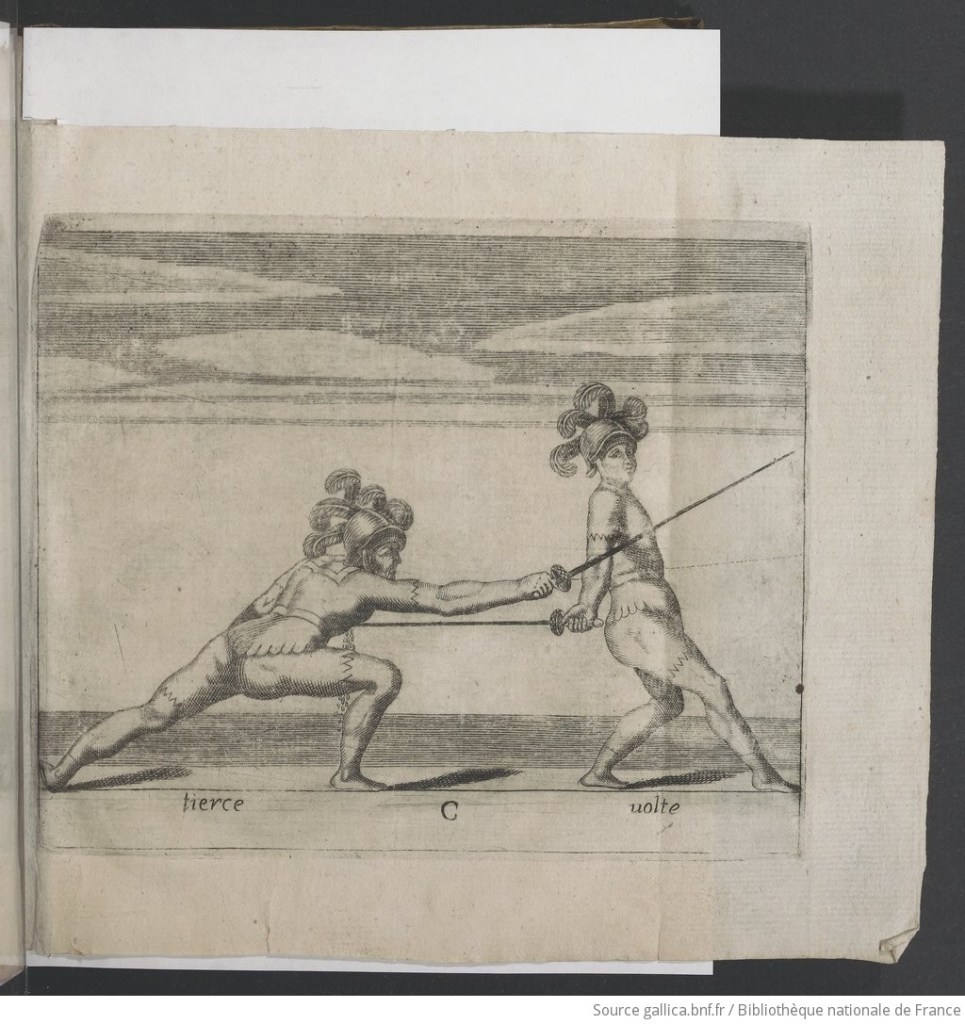
A concise interpretation of the techniques
In the outline above, I did my best to simply list the topics in the order they appear. In this section, I present a brief, superficial interpretation of the techniques described in chapter 2 based off of my reading of the text.
Besnard introduces techniques by first describing the overall starting situation (who is engaging whom and in which position). He then partitions the starting situation into an exhaustive list of possible continuations. For each continuation, Besnard offers a list of techniques the fencer can use to emerge victorious. Sometimes, Besnard explicitly states when and why one option is to be preferred to another. Other times the options are presented as equally viable alternatives for the given continuation.
When engaging your opponent, you close the direct line of attack with your blade engagement. Besnard never addresses the situation where your opponent attacks the line you have closed directly; presumably, it would be foolish for your opponent to attempt that if you have engaged your opponent properly. Besnard generally recommends placing your half-strong and true edge against the opponent’s weak to engage8. However, he also writes that it is not strictly speaking necessary for the blades to touch to achieve some level of restriction of your opponent’s options9. Regardless of the starting position of the fencers, Besnard describes four relatively analogous possible continuations which I have called “Case 1”, “Case 2”, “Case 3” and “Case 4” here.
When your opponent is engaging you, Besnard addresses more possible continuations and, in my opinion, his partitioning of the situation is less systemic than in the situation where you are engaging your opponent. However, this is only because the reader does not need as much detail as the similarities to the previously described techniques become clear.
The outline below is intended to be a comprehensive list of techniques Besnard describes (according to my reading of the text). In the original text, the techniques are described in more detail and differentiated by starting position. As such, this list – while in my view comprehensive – represents a condensed, abbreviated overview without the specific advice present in the original treatise. My goal with this outline is to give a reader familiar with fencing terminology a general idea of the sort of fencing Besnard describes.
- When you are engaging your opponent
- Case 1: Your opponent disengages to attack you on the other side of your sword
- Parry with true edge, riposte
- Parry with false edge toward your outside, riposte
- Circular parry with hand high & point low, riposte
- Counter-disengage, parry, riposte
- Hanging parry on your inside, riposte with cut
- Void with a volte while counterattacking (see figure on the right in Plate C)
- Void by dropping your torso low while counterattacking (see figure on the left in Plate B)
- Parry with true edge, passing step forward, hilt grab, present point
- Parry by pushing upwards, cut under opponent’s wrist into seconde
- Case 2: Your opponent disengages without attacking (either to feint or just change sides)
- Counterattack by thrust with opposition if you don’t believe they have a plan
- Counterattack with void by volte (compare to #6 in Case 1)
- Counterattack by void while dropping down low (compare to #7 in Case 1)
- Use a half-botte to test your opponent
- If they attack, parry riposte
- If they parry, go through or around it and continue your attack
- If they do nothing, finish the half-botte as a full one
- Case 3: Your opponent tries to take over the advantageous position in the engagement
- Yielding thrust, passing step forward, hilt grab, present point (compare to #8 in Case 1)
- Disengage to other side, thrust
- Disengage by dropping low, thrust (compare to #7 in Case 1)
- Use a half-botte to test your opponent (compare to #4 in Case 2)
- Case 4: Your opponent does nothing and remains engaged
- Use a half-botte to test your opponent (compare to #4 in Case 2)
- Beat your opponent’s sword in preparation then thrust
- Case 1: Your opponent disengages to attack you on the other side of your sword
- When your opponent is engaging you
- If you need more time, retreat
- If your opponent is chasing you down and you cannot retreat fast enough, drop low to counterattack in seconde when they begin a step (compare to #7 in Case 1 when engaging)
- Follow up with pass, hilt grab, present point (compare to #8 in Case 1 when engaging)
- If your opponent closes measure but does so in a composed manner, use a half-botte to test your opponent (compare to #4 in Case 2 when engaging)
- If your opponent is engaging you passively, waiting for you to act first:
- Disengage and attack in one motion, but let him parry you
- Return to guard leaving the obvious opening for his riposte
- Counter the riposte as you would counter an attack on that side usually
- If your opponent attacks directly from their position of advantage in the engagement:
- Counter the attack by one of the methods already discussed
- Counterattack while voiding either by…
- dropping low into seconde (compare to #7 in Case 1 when engaging)
- turning away with a volte (compare to #6 in Case 1 when engaging)
- If your opponent feints to draw out a reaction:
- Give your opponent the reaction they expect, moving to parry the feint, knowing which line you are opening while doing so
- When they avoid your “parry”, use one of the counters previously discussed on their real attack
- If you have enough time to respond as your opponent is initiating the engagement, avoid the engagement
- If your opponent attacks in the tempo of your avoiding the engagement, use one of the counters already discussed
- Otherwise, you engage your opponent on the other side (then proceed as in the section where you are engaging above)
- Chauvat, Anne and Rob Runacres. The Free Master of Arms. Glasgow: Fallen Rook Publishing, November 2022. ISBN 978-1-913066-02-4. Page 3 ↩︎
- The Free Master of Arms, 2022. Pages 18-21 ↩︎
- The Free Master of Arms, 2022. Pages 21-22 ↩︎
- The Free Master of Arms, 2022. Page 157 ↩︎
- The Free Master of Arms, 2022. Pages 148, 163 to name two examples ↩︎
- The Free Master of Arms, 2022. Page 136 ↩︎
- The Free Master of Arms, 2022. Pages 163, 193 to name two examples ↩︎
- The Free Master of Arms, 2022. e.g. Pages 161, 170, 176, 180 ↩︎
- The Free Master of Arms, 2022. Page 182 ↩︎
 Blume des Kampfes
Leave a comment