Category: Pädagogik / teaching
-
Fiore Beginner’s Guide
Eine deutsche Version dieses Beitrags findest du hier. I created a beginner’s guide to Fiore! This is my interpretation of the most basic actions Fiore shows (with a focus on the sword in two hands without armour) and my take on the basics of unarmoured longsword fencing. My goal was to create as simple and concise…
-
A modern gloss on Fiore’s longsword

Introduction Fiore’s art of arms is not easy to summarize because it is not presented as an outline of principles or a how-to manual, but as a set of illustrative examples. This is consistent with the scholastic method of teaching that was common in the middle ages. This a form of inductive pedagogy, where the…
-
Revisiting old Perspectives
Over the last couple months, my perspective has shifted on several subjects in historical fencing. Looking back, the insight seems obvious, but until the idea was presented to me, I probably wouldn’t have considered it since I had unspoken assumptions about the subjects that kept me from considering them. Hit Quality: What about your buddies?!…
-
Hit Quality and Aspirational Fencing
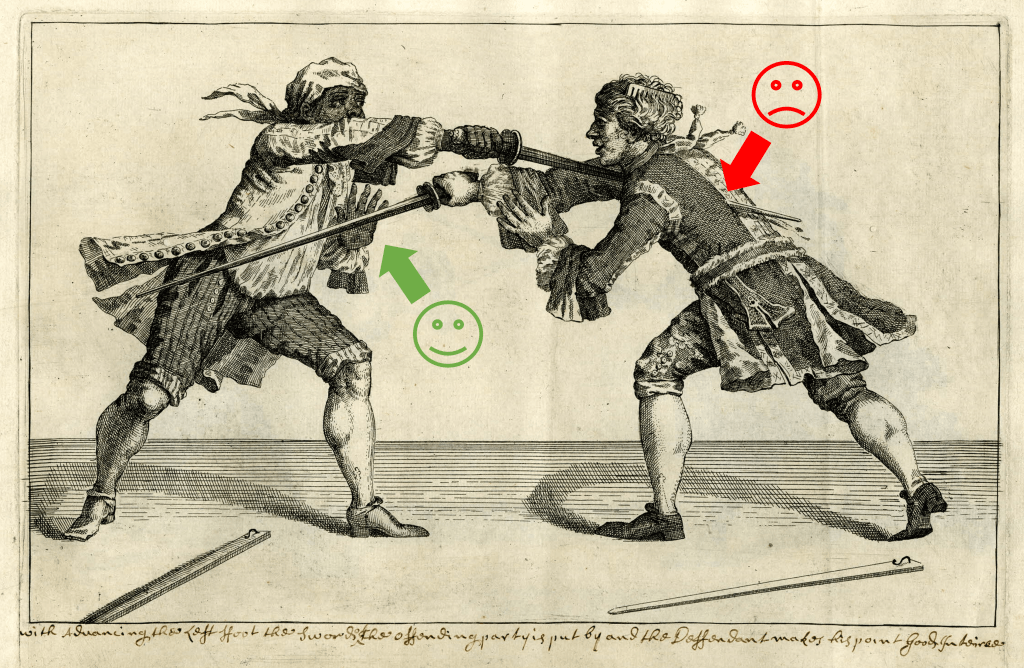
Eine deutsche Version dieses Beitrags findest du hier. The goal in fencing is to hit the opponent without being hit in return. More specifically, we want to hit effectively without being hit effectively in return. What “effectively” means is context dependent and sometimes ambiguous. In modern Olympic sport fencing, for example, touches are detected by an…
-
What’s your “fencing ideology”?
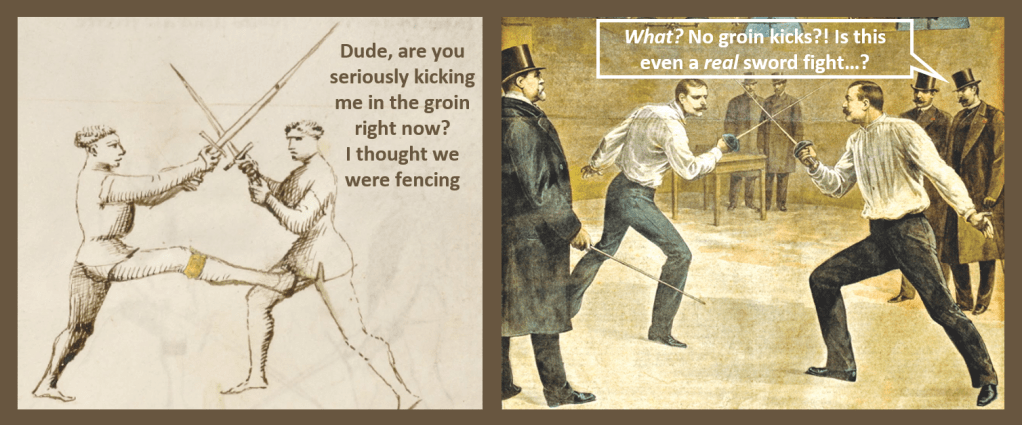
Eine deutsche Version dieses Beitrags findest du hier. The word “ideology” comes with a lot of baggage. For some, an “ideology” is a dogmatic dedication to a set of beliefs; “rational” people don’t have an ideology, they just have beliefs they arrived at “rationally”! I don’t think about it that way. For me, an ideology is…
-
Was ist deine “Fechtideologie”?

You can find an English version of this post here. “Ideologie” ist ein sehr vorbelasteter Begriff. Für manche ist eine “Ideologie” eine dogmatische Hingabe an eine Reihe von Glaubenssätzen; “rationale” Menschen haben keine Ideologie, sie haben nur Überzeugungen, zu denen sie “rational” gekommen sind! So sehe ich es nicht. Für mich ist eine Ideologie ein Modell…
-
Fiore kurzgefasst: Tiere und Tugenden

In der Mitte des Getty-Manuskripts legt Fiore eine Pause von der Darstellung von Techniken ein und geht ein kurz auf die Werte seiner Kampfkunst ein. Abgebildet wird ein Mann umgeben von vier Tieren, die die vier Tugenden der Armizare symbolisieren. Diese Darstellung kommt auch in den Pisani-Dossi und Florius Manuskripten vor. “Die sieben Schwerter dieses…
-
Fiore kurzgefasst: Manuskripte, Meister und Schüler
In einem anderen Beitrag habe ich die ganze Kampfkunst von Fiore de’i Liberi kurz zusammengefasst. In diesem Beitrag geht es darum, die überlieferten Manuskripte und Fiores Überlegungen zu seiner Pädagogik kurz vorzustellen. Vier Manuskripte von Fior di Battaglia sind bekannt: Das Getty-MS ist das detailreichste der vier Manuskripte (wobei die anderen Manuskripte manchmal zusätzliche Details…
-
Sport Fencing vs. Historical Fencing
The modern practice of “historical fencing” is difficult to define. While the debate about what constitutes historical fencing will certainly never end, most definitions include at least a couple of the following characteristics: In the historical periods we study, what we now call “historical fencing” was, of course, just “fencing”. We have “fencing” today too…
-
Wie denke ich über das Fechten nach?

Fechtaktionen können in drei Kategorien unterteilt werden: Die Kernfrage im Fechten ist: Wie treffe ich meinen Gegner, ohne dabei getroffen zu werden? Eine Antwort auf diese Frage enthält immer einen Angriff, da Angriffe alle Fechtaktionen umfassen, die zu einem Treffer führen. Wenn man sich vorstellt, dass der Gegner das gleiche Ziel hat wie man selbst,…
 Blume des Kampfes