
Eine deutsche Version dieses Beitrags findest du hier.
Whether discussing a sword, an airplane, or a washing machine, the traits of that thing can be divided into “hard” and “soft” factors. These two categories exist to differentiate between different kinds of characteristics that affect performance.
What are hard and soft factors?
- Hard factors are traits that are important to the utility of the thing and can be objectively measured
- Soft factors are qualitative traits that are important to the utility of the thing, but are difficult to measure and express in numbers
Every sword design has various hard and soft factors. For example,
- Sword Design
- Hard factors
- Length
- Weight
- Point of balance
- Blade shape and profile
- Surface area of the guard
- etc.
- Soft factors
- Ease of use
- Ease of transportation
- Ease of maintenance
- Fashion
- Social or cultural significance
- etc.
- Hard factors
Hard factors are the easiest to understand because they directly affect performance. A sword with a longer blade has greater reach. A sword that is heavier requires more effort to accelerate and decelerate. A sword with two cutting edges can cut with both the front and back edge. Duh.
Soft factors are the easiest to overlook, because they often only indirectly affect performance and are often context dependent. Gold decorations on a medieval knight’s sword and armour will not necessarily affect his ability to fight, but the gold says to his peers “I’m rich and important, you should give me special privileges!” and to his enemies “Don’t kill me! My family can probably afford a large ransom.”
Some soft factors are particularly easy to overlook for historical fencers because they were relevant historically but are not necessarily relevant today:
Ease of wear
One of the reasons for the sword’s historical popularity is its utility as a side arm. The sword is a weapon that can be conveniently worn at the side and carried through everyday life without getting in the way too much. Even the sword of a particularly pugnacious Condottiero will spend the vast majority of its active life being worn or carried, not fought with.
However, modern historical fencing is concerned with the fencing part of historical swordsmanship. We don’t (typically) wear period clothing or wear our fencing swords while not using them. As such, ease of wear is essentially irrelevant for our purposes, even though this would have been a very practical consideration historically.
Robinswords has a great video (1:30) outlining some specific practical considerations about convenience of wear.
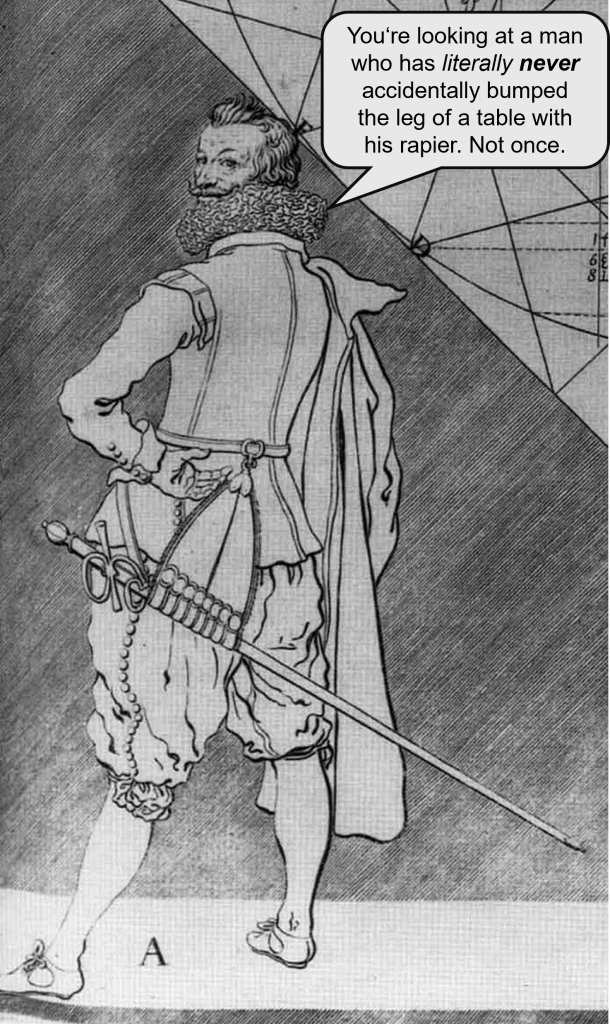
Ease of deployment
Barring a handful of exceptions, almost all contemporary historical fencing bouts and competitions begin with weapons drawn. This is appropriate for approximating something like a duel, but I’m sure you can imagine many historical scenarios where a person wearing a sword might need to draw the sword quickly and unexpectedly.
The longer the blade, the harder it is to draw the sword. In fact, if you want to be able to wear and draw your own sword without help, there is a hard upper limit to how long your sword can be. Complex hilts can also make drawing the sword slightly harder.
Because historical fencing typically starts with weapons drawn, the soft disadvantages of longer weapons are downplayed and the soft advantages of shorter weapons are practically irrelevant.
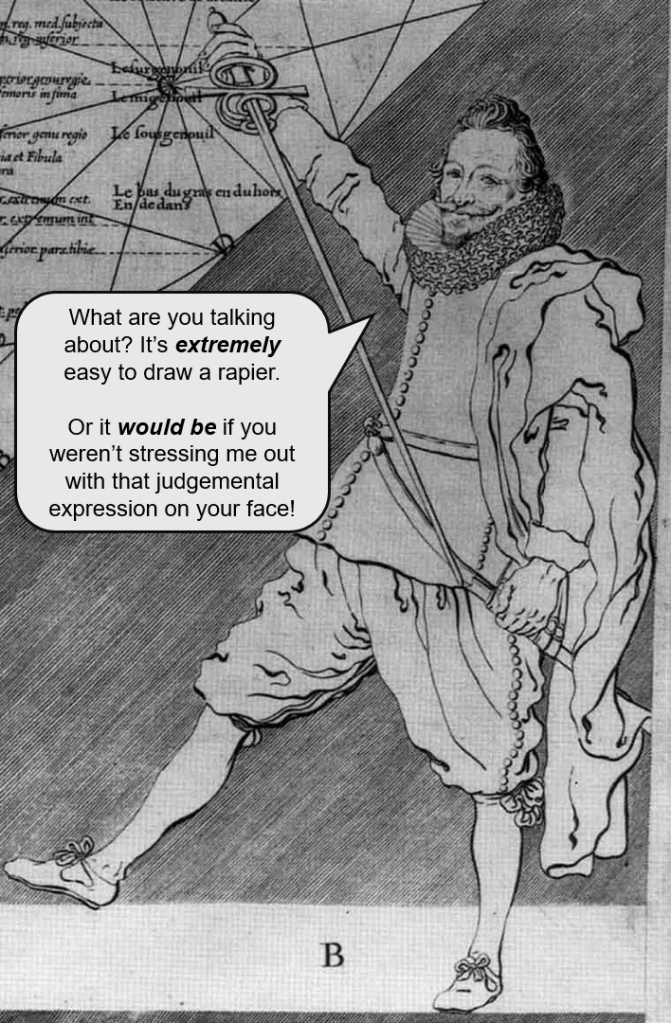
Stopping power
Many historical sword designs are (unsurprisingly) optimized for delivering devastating cuts to increase the probability that a successful hit is also an effective one. One way of doing this is by changing the mass and mass distribution in the blade. All other things being equal, a heavier blade will cut better and, therefore, more probably end the fight in a single blow. However, a lighter blade can accelerate, decelerate and define blade engagements more quickly (all of which are very useful for offense and defense) while still retaining the possibility that a single blow will end the fight.
In fencing, a heavier blade increases the risk of actually injuring our opponent and it is not practical to adjudicate the quality of cuts differently for different blade profiles. As such, “stopping power” is practically irrelevant for the modern historical fencer (and perhaps even counter productive if you want keep your training partners healthy).
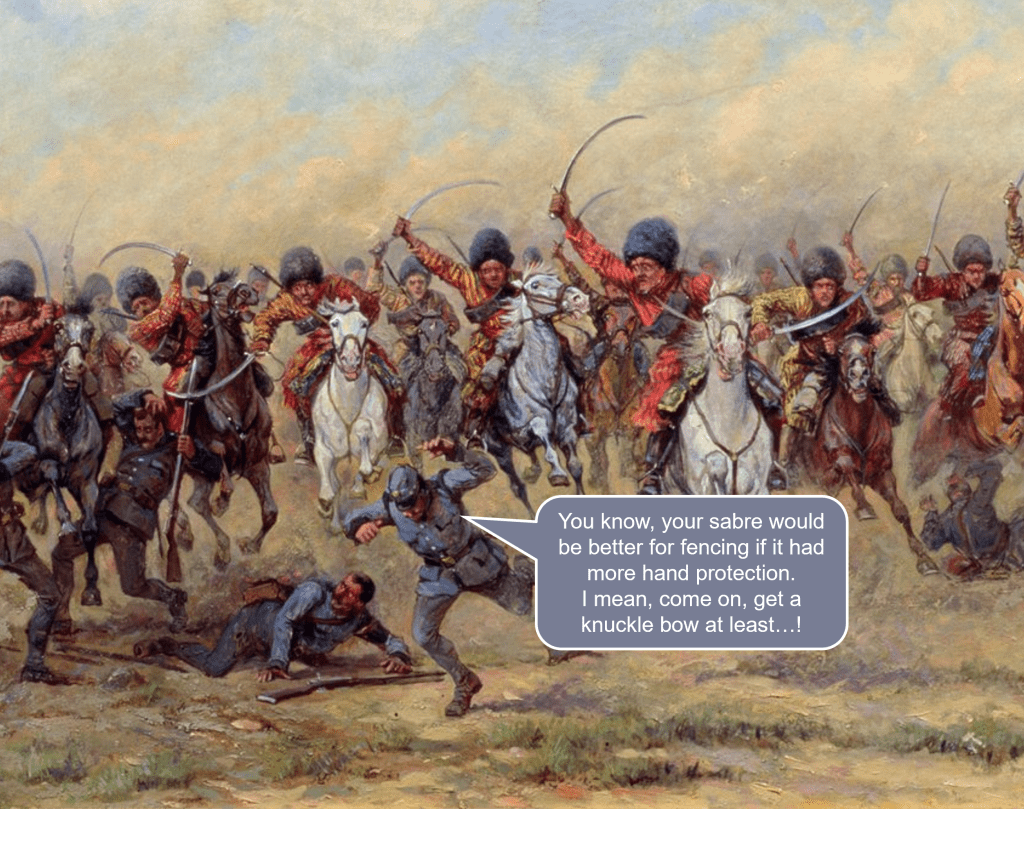
Flexibility vs. Specialisation
Diversity of contexts is one reason for the observed diversity of sword designs. Specialised tools will always be better at the job they are specialised to do, yet a few sword designs seem to remain consistently popular across time and cultures because they do well in a variety of contexts despite not being the “best” in any of them. As the saying goes, “a jack of all trades is a master of none, but oftentimes better than a master of one”.
“Context” is basically a meme in historical fencing for good reason, so this isn’t really something that historical fencers “forget”. However, one might forget that the contemporary historical fencing scene is, itself, a historical context. That context influences the (training) swords that we use and that manufacturers produce. The historical fencer also knows what context they will be fencing in before they grab a sword from their fencing bag, so there isn’t really any practical reason not to pick a more specialised tool when such a tool is available. The soft advantages of more generalist tools are, therefore, less important in our context.
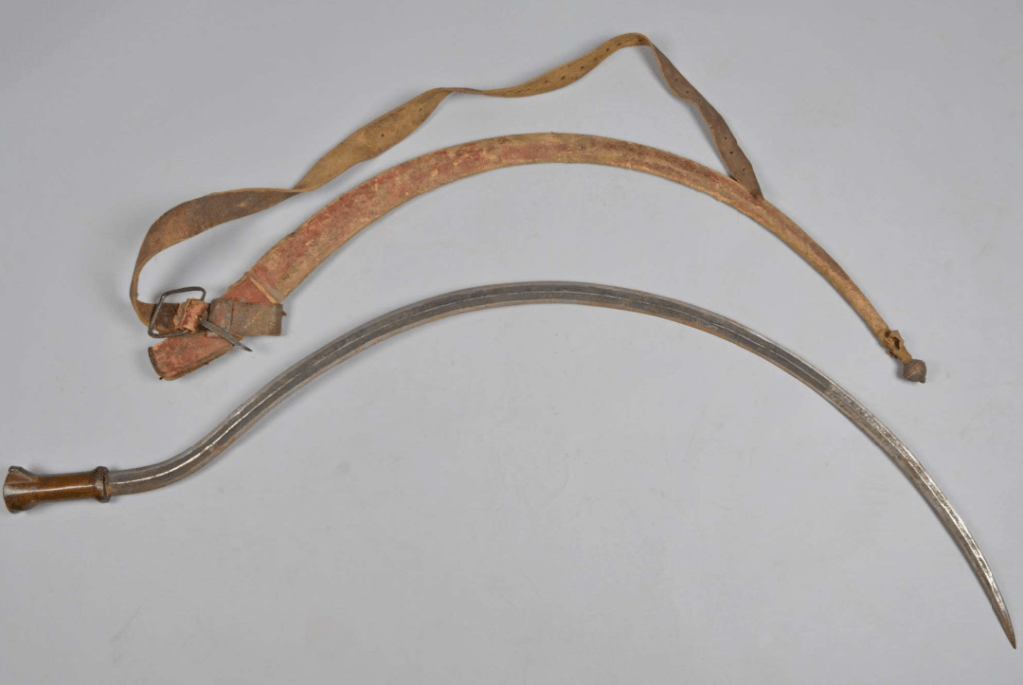

Top: 19th century Chinese Dao
Bottom: 16th century Italian sabre
Cost
Although modern historical fencers can certainly appreciate that training swords are often quite expensive, the difference in cost between different kinds of swords is usually not so great as to make one kind or another prohibitively expensive.
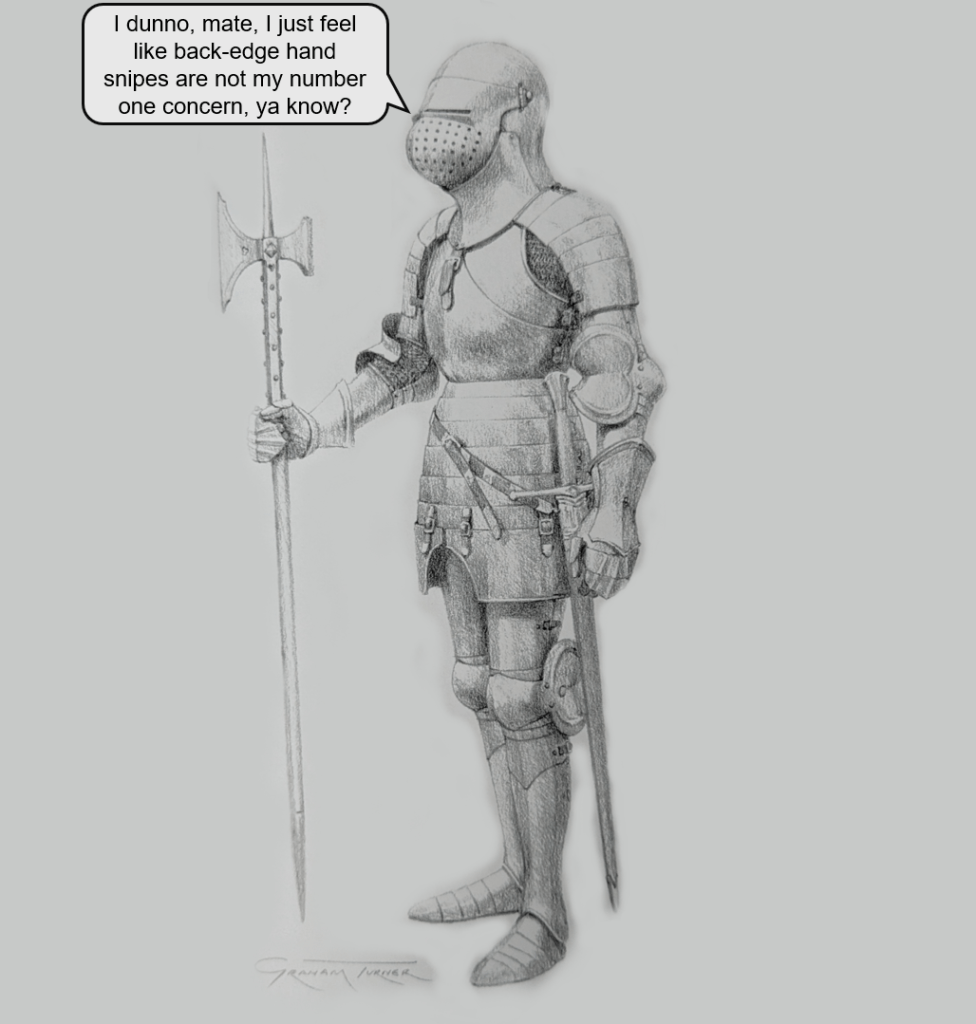
One place where cost is prohibitively expensive for most people is armour. The average modern historical fencer studying a medieval longsword source, for example, probably places a much greater emphasis on fencing out of armour than a person from the knightly class would have in period simply because it’s expensive to get into armoured fencing. While we might pay lip service to the importance of armour in period, our lived experience will be biased towards unarmoured fighting and techniques, and this influences our perception of medieval fencing.
 Blume des Kampfes
Leave a reply to Harte und weiche Faktoren – Blume des Kampfes Cancel reply